Revive, Reflect, ReviseThe 3 “Rs” of a Teacher’s Summer
As summer approaches, we begin to think about, and plan for, the next school year. We can’t help it. “It must be so nice, having your summers off!” Yup, it is. It really is. But the validity of this statement really depends on your definition of “off.”
Revive
The time between May(ish) and August(ish) is when we recharge our batteries and gear up for what is coming at us. It is important to have a hiatus from that breakneck pace of the typical school year. This summer break is a teacher’s opportunity to have more flexibility in scheduling, task completion, and bathroom breaks. Take some time and catch up on your personal reading list, visit with friends over coffee, or check something off of your bucket list.
This is also the time where we feel we can take on something new. When confronted with the daily survival mode of the classroom, it is difficult to imagine tackling a new curriculum, technology, or pedagogy. It is during the summer “off time” when these new skills and experience can be put into focus. Explore something new and re-energize your professional spirit. As educators, it is important that we continue to learn and grow in our profession. It then models the importance of life-long learning for our students.
Reflect
It is important to first recharge your professional enthusiasm. Take some time with no students, no correcting, and no bells. Once you are feeling like yourself again, it is time to practice what we encourage our students to do every day...reflection on our work.
Thinking about our process and our practice is a critical component for creating a successful learning environment. What went well over the past school year? What would you like to change?
Revise
Anyone who works in education knows that the summer months are when any significant revision work happens. During the school year, many of us are simply operating in survival mode. It is only after a break and reflection that we can really focus on implementing change.
Professional growth is a very common and important part of a typical teacher’s summer. What do you want your classroom to look like next year? After reflecting on your past year(s), is there something you can maximize or leverage as you work toward your new goal? What tools and/or learning experiences do you need to assist you with that change?
One way to stay connected and participate in some asynchronous professional development is with the Twitter Chats and Hashtags. Find a chat that appeals to you and check in once in a while. Need some inspiration? Check our our BPS Twitter Resources.
We already know that feedback is a great way to stimulate student reflection and critical thinking, but it may very well be one of the biggest contributing factors to creating a growth mindset. Paul Black also tells us that “It is the nature, rather than the amount, that is critical when giving students feedback.” (Black and Wiliam, 2002). This may actually be simpler than we think. Simple reactions and observations (like the one pictured below) are a great place to start.
Let me tell you a story about one of my feedback experiences:
It’s late summer of 1995, or maybe ‘96 - that decade was kind of a blur for me - and I find myself at the World Tug of War championship (it’s a real thing) in Madison, WI. No, not as a contestant, as entertainment. I was playing in an original blues/r&b band, and it was our job to ensure that everyone had a good time after a hard weekend of “tug-of-warring.” To be honest, we weren’t excited to be there - not exactly our type of crowd. We suffered through the first set during which we received some very clear feedback from our audience: they were definitely not engaged or motivated by our efforts, and they didn’t have to format their feedback into “wonders,” or “wishes” for us to get a clear picture about our progress towards the desired outcome. Our regular repertoire wasn’t working.
O.k., time to engage some critical thinking and problem solving skills, display some flexibility and perseverance, engage our creativity to brainstorm some divergent solutions, take a risk, and [insert other applicable skills from the 4C’s and 21st century skills here]... In any case, it was pretty obvious that we would have to do something.
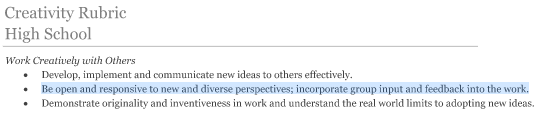
That’s when our band leader turned around and called a song we’d never played as a group before. This might not have been so bad, except that it was a tune that our collectively unwritten music snob code made it a total embarrassment to play in public. However, we were desperate, so it was time to be open and responsive to new and diverse perspectives and incorporate group input and feedback into our work.
Slowly but surely, our disinterested audience began to drift towards the dance floor, and a small contingent of them actually began to look like they might be enjoying themselves. We ended the song and our band leader turned to us on the bandstand and yelled,
“Hey, it’s working! What else do we know that stinks?”
So who is the teacher and who is the student in this story? Does it really matter? In hindsight what really seems to be important is that the band and the audience were engaged in a learning loop and working towards a common goal. I would be willing to bet, however, that if someone in a position of authority had given us “advice” (prescriptive feedback) in the form of telling us what to play or how to play it, the evening wouldn't have ended as well as it did. When a specific suggestion came from a peer (our band leader) as a response to the crowd’s reaction, though, we were able to collaborate effectively to reach the desired result. The audience’s reactions, our leader’s observations, and our willingness to take action on the feedback that we observed are what helped us to close the gap.
One of the biggest factors that pushed me towards implementing a more feedback oriented approach in my classroom was (what I perceived as) a lack of student engagement and motivation. My students didn't seem to be engaging with the material that I presented and producing evidences of understanding at a level that I interpreted as proficient, so I would assign more practice...only to receive, at best, the same results, and, at worst, student refusal to continue at all. Finally, I realized that what I was wanting from my students was better work, but all I was giving them was more work, and while these two things aren't necessarily mutually exclusive, there is definitely a big difference between them.
Check out this great example of how clearly communicated goals, and specific peer generated feedback can help to generate improved quality in student work.
These days I’m doing my best to create situations where students have to communicate with each other regarding the quality of each other’s work and identify what they need to do to improve using their own critical thought processes before they submit their work to me for assessment. This has made my work easier and clearer in the following ways:
While my students are collaborating and communicating regarding each other’s creativity (which also generates opportunities for them to think critically about their own work), I can observe and assess their progress in these important areas. Plus, it frees me up to observe student engagement with content standards, and watch learning emerge from confusion. These observations can get recorded and reported in powerschool.
When I finally am able to assess their work on content-related standards, I am more confident that the products that they are submitting or presenting are not first iterations done in haste shortly before the due date. This also makes me more confident that the reports I’m making in the form of grades are more accurate and meaningful.
When my students do fall short of the mark, I am able to provide them with feedback that connects their academic success to their proficiency in the 4C’s, and this, in turn, creates a learning loop that reinforces and encourages positive student behaviors and a growth mindset.
Sometimes it works great! Other times...not so much. Nurturing this learning loop and growth mindset is still a lot of hard work, but I've found that it is much more rewarding than chasing down “late” assignments. I’m definitely always on the hunt for good ways to enable and facilitate student collaboration. Got any feedback on how you keep students engaged and motivated to produce high quality work? Please feel free to comment below!
Students become engaged and invested for a variety of different reasons. While the initial “hook” varies widely from student to student the professional challenge of leveraging student investment for academic achievement takes deep thought and continuous work.
A few years ago Dr. Rodenburg was wondering what student responses would be to the question “What are you most excited about when you walk through the school door in the morning?” For fun I remember asking my then 9 year old. His response, “Breakfast and the conversation.” His hook was conversations about whatever was happening in the sports world with a morning supervisor. This hook played out throughout the next few years as my son, a reluctant reader, got up each morning to review the sports news in the newspaper so he would have the information he needed to engage, at a highly competent level, in the conversation.
Over this past year, we (Technology Department Staff) have had an opportunity to interview a hundred or so students about what engages them academically. I don’t think it will shock anyone to learn that technology, in and of itself, was not an academic engager. Being engaged as a contributor to the “conversation” was a theme from many students. The students we spoke with had ideas and wanted to be able to contribute their ideas and expand on them through deep discourse with others. These students also reinforced many of the key factors from research on student engagement. Students insisted they want to be self-directed and competent. Students who were provided online environments indicated a feeling of being more independent and this gave them a sense of control over their learning. Our whole team was impressed with our students desire to have ownership in their learning. One big take-away on student engagement was the progress we could make by building relationships with students that leverage what already “hooks” them.
Use the hook to get students actively involved and emotionally committed. Then, as a professional community, collaborate together to leverage this student energy for cognitive investment across all subjects.
Can differentiating between formative and summative assessment be as simple as making soup? As Paul Black describes assessment practices, “When the cook tastes the soup, that’s formative assessment; when the customer tastes the soup, that’s summative assessment.” Even though there are multiple definitions and analogies to clear up the differences, there isn’t a more powerful way of increasing one’s understanding than experiencing formative and summative assessment as a learner in a real-life situation.
The difference for me was clearly articulated when I, the “student,” picked up a drill for the very first time while my dad, “the teacher,” provided me with a balanced assessment system. Smarter Balanced, our state’s assessment consortium, is an advocate for the importance of this system, which is defined below:
A balanced assessment system — which includes the formative assessment process as well as interim and summative assessments — provides tools to improve teaching and learning. The formative assessment process is an essential component of a balanced assessment system.
Connecting the four attributes of formative assessment defined by SBAC to everyday practices can increase our understanding of this ambiguous process.
So, how do these four attributes connect to real-life experiences?
As was mentioned in the second paragraph, the importance and intent of this seemingly ambiguous process was clarified when I became a “student.” A drill is something I never needed until I moved into a new home where blinds needed to be mounted, beds and dining room chairs needed to be put together, shelves hung, etc. After attempting to begin a few of these projects with a Phillips screw driver, I knew there had to be another alternative. On a cold day in January, I made a trip to Ace Hardware and bought a Dewalt drill, which was on sale. I looked at that foreign object just like a first-time mom with no babysitting experience looks at her brand-new baby . . . not sure how to hold it or simply what to do with it.
If my dad and I were in an educational setting, he would have given me the following learning targets to clarify intended learning.
I can adjust the settings to make the bit turn to the left or to the right.
I can drill different sized holes with a drill bit.
I can develop a sense of flexibility in the bits I use as I am working with different projects.
I can explain what the numbers mean on the handle and am able to use them effectively and appropriately in a variety of settings.
I can explain what the numbers (1 and 2) mean on the switch and am able to adjust the settings appropriately in a variety of situations.
I can create a project by using a variety of bits and screws.
Not only did my “teacher” understand the outcomes, but I did as well. It would have been extremely helpful to have a self-monitoring tool, similar to the one we used at the middle school level while teachers were becoming familiar with standards-based grading. Click here to view this tool - one that would have given my dad and me specific steps in what the “student” needed to do in order to be proficient in each learning target.
As an effective “teacher,” my dad gave me multiple opportunities in different settings (mounting blinds and TVs, hanging towel racks, assembling dining room chairs, etc.) to elicit evidence. Collecting evidence of learning was either spontaneous (click here for a list of formative assessment ideas) or a planned event (completing the final product) .
Interpreting evidence Through observations, conversations, and the quality of the products, my “teacher” and I were able to determine my strengths and possible gaps in my understanding.
Acting on evidence As I was practicing the learning targets, my “teacher” provided “timely, descriptive, and actionable feedback” during the learning process. While hanging the blinds, the drill bit wasn’t catching onto the screw. My dad said, “If you don’t put enough pressure on the screw, it will continue to give you problems. Once the bit is lined up properly, focus on applying pressure to keep the bit from leaving the screw. You may also want to decrease the speed to see if that helps.”
As a learner, I was extremely grateful that my “teacher” didn’t assign practice tasks that were not meaningful. Practicing the task of making the bit turn right or left when I had already reached proficiency would have been frustrating and there would have been a delay in the opportunity to obtain proficiency in other areas. In order for the learning to keep moving forward, it is critical for teachers to know where each individual student is in regards to reaching proficiency. As a teacher, this can be somewhat overwhelming, but when students are also documenting their progress, it becomes a team effort. Refer to the self-monitoring sheet below that these Algebra II students are using in Mr. Nate Welstad’s class.
Students complete the sheet as they move closer and closer to proficiency. Under each learning target, there are suggested “practice” problems for those students who haven’t reached proficiency yet in that area. Like me, I am sure his students appreciate the opportunity to take control of their learning by practicing the skills that they have identified as partially proficient.
Whether it be the soup you are making, a product you are assembling, or skills you are learning in Algebra II, providing or obtaining effective feedback during the formative assessment process is critical in the learner’s success in reaching the end goal.
What steps are you taking as a teacher, parent, administrator, staff developer, etc. to assist your “learners” in moving towards proficiency? Are you engaging them in a balanced assessment plan?
“O.K., great - I’ve got a balanced assessment plan...now what?” How do I implement good feedback practices? What does it look like in powerschool? How will I know if my plan is helping my students move past proficiency? How do I manage all of this? Stay tuned for some thoughts on these issues...until then, feel free to post your questions or ideas in the comments section below."
One of my most inspirational yearly projects is working on a team to plan and produce the student “voice” component of the district opening day. In one way or another we gather a sample of students and ask them to describe their most positive learning experiences. Each and every student in these interviews speaks of times when they were highly engaged and passionate about learning. They also speak of the conditions that best supported this deep learning. The “standout” conditions include having caring and passionate teachers, working on more in-depth projects, and having input and choice.
When I think of student choice I think of co-constructing the learning experience with students. Admittedly, accomplishing this takes some rethinking of traditional practices. Thankfully there is a whole continuum of strategies one can use to provide more student choice. The choices students described in the interviews fell far below co-construction and yet they still rose to the top of what students described as their best learning experiences. Students described how they felt more valued and trusted when they had choices and input. The choices students referenced included simple things such as choosing a research topic, choosing how to present (methodology), and choosing between several books or projects.
As we think about how to engage students in their own learning consider ways to increase the student voice and choice opportunities in your classroom. Moving from the simple to more complex with students as co-constructors of learning that includes student voice and choice in content, process, product, and evaluation.
For ideas on how to cultivate more voice and choice in your classroom check out this article 5 Ways to Give Your Students More Voice and Choice on EduTopia at: http://goo.gl/DDQeit.