Tuesday, March 29, 2016

North Dakota State Assessment

We are well under way now with the second year of the new North Dakota State Assessment (NDSA).  This year’s roll out has been a lot smoother than last year.  We have not seen the server and code problems that we dealt with last year.  The interface seems more user friendly and I am hearing positive comments from teachers who have already administered the test.  As of just before spring break 500 testing segments had been started and 360 of them had been completed.  This includes both ELA and math in both the computer adaptive test (CAT) and the performance task (PT).  The adaptive portion of the test will give students easier or harder questions based on how well they are doing but it won’t start until it is confident in a student’s ability.  It also will not leave the students grade level.  Hopefully that will change so that we can get a more accurate picture of a student’s ability if they are well above or below grade level. 

The first week back from spring break will be a big test for the NDSA as more schools will be coming online and more students will be testing at the same time.  We have several more schools who will begin testing now in April. 

Students who took the NDSA last spring did not receive results until late this fall and their individual student reports that were shared with parents did not come in until February.  That is almost a year after the student took the test.  That delay impacts our ability to use the data in meaningful ways for the students.  Historically the NDSA was not an assessment that drove instruction but rather it was used by the North Dakota Department of Public Instruction (NDDPI) to determine Adequate Yearly Progress under No Child Left Behind (NCLB).  Our test scores were part of a formula that also included participation rates, and either graduation rate or attendance rate depending on the grade levels of the schools testing.  Now that NCLB is a thing of the past and is being replaced by Every Student Succeeds Act (ESSA) NDDPI gets more control over what determines AYP so they are putting together a team this spring to begin work on what AYP looks like and how our student’s test scores will play into it.  If we receive test scores sooner this year as we have been promised the data will be more useful for our students and teachers. 

Did you know that the current state assessment in reading and math came about in 2001 legislation in response to requirements of the federal law NCLB. House Bill 1293 required schools to give a state assessment in reading and mathematics once each year to public school students in grades 3-8 and 11.  It also required schools to test students in science in one grade chosen from 3-5, once in 6-9 and once in 10 or 11th grade.  Prior to this law schools tested students in grades 4,8, and 11 in ELA, math, and science.  Even before we had the common standards of the Common Core we took a test that was based on another state’s standards.  Some may remember when their students took the Iowa Basic Skills test.  In fact when I became superintendent in Divide County I found some old test records from those days. 


Assessment has always been a part of education and always will be.  It is what we do with the results and how it impacts our instruction that has evolved and will continue to evolve. 

As I reflected on this blog I had to laugh at the number of acronyms we use in education.  I have heard from those outside education that it can be confusing but seeing so many in one place puts it into perspective.

Monday, March 21, 2016

BPS Camp Edventure

When one thinks of summer camp some of these things may come to mind; outdoor activities, new friends, super cool camp leaders, a bazillion bugs, hot days with sudden rain showers, scavenger hunts, and of course singing around the camp fire. This a quite a different definition than summer school, but does it have to be all that different? Camp Edventure is the free six week elementary summer school program that Bismarck Public Schools offers for students entering first grade through fifth grade the following school year. This summer the goal is to put that adventure  that the name implies into the program, while continuing to follow the guidelines the state requires of the program, two hours of math and two hours of reading each day.

One way to do this is to integrate the high interest content areas of science and social studies into the reading and math classroom through the process of inquiry. The definition of inquiry is an act of asking for information or in other words, asking lots of questions and doing lots of research and investigating to get an answer to something you are wondering about. There are many educational inquiry models out there, but basically the process follows these steps, wondering, investigating, recording, discovering, thinking, trying, and finally reflecting. This process can easily be integrated into the reading or math classroom by changing the way a teacher poses the activity. This process also provides higher student engagement, fosters deeper understanding, and provides students the opportunity to think critically about their learning.

Camp Edventure teachers will have the opportunity to be involved in a day and a half planning session with colleagues to develop and prepare a three week or six week project based on inquiry. By creating these opportunities for teachers to collaborate and allowing them the flexibility to create curriculum based on reading and math learning goals, the 1,800 or so students that attend Camp Edventure will be able to feel that sense of adventure as they head to summer school this year.

The registration deadline is March 25, 2016. Get those forms turned in, in order to guarantee your child a spot for Camp Edventure.

Article by Brenda Beiswenger, Principal at Prairie Rose Elementary School

Monday, March 07, 2016

Innovation in Schools

What does innovation in schools mean? I believe innovation in schools highlights those practices we implement that have never been implemented in the past or those practices that are in place that we have found ways to improve.  Working with business and industry, whether it is sending students out into the workplace or bringing experts in to mentor our students on specific projects, is one example of an innovative practice. Changing up your classroom to provide flexible work spaces is another example of an innovative practice and is easy to try with low risk.  So what have you tried lately to take a risk and improve your classroom or instructional practices?

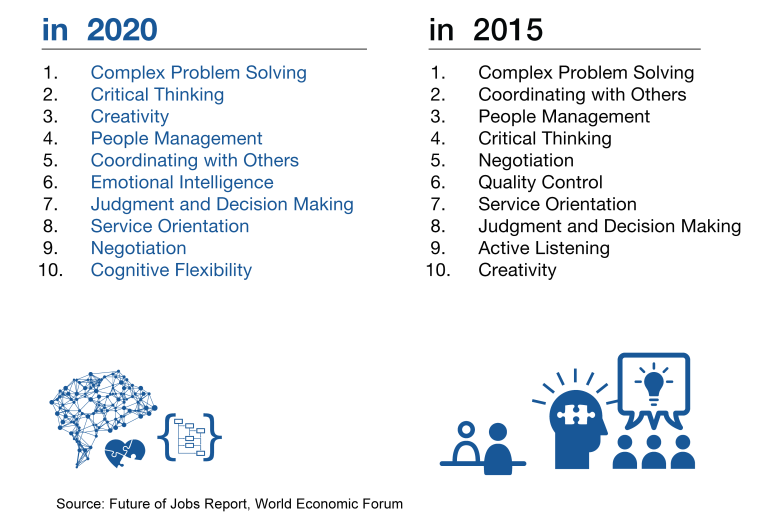
In February, a team of 7 of educators participated in the Innovation Summit at the Douglas County School District in Colorado. I was lucky enough to be included in this amazing professional learning opportunity!  We began the week with school visits to both high schools and middle schools. We noticed that students were focused on authentic projects that they designed and many were working toward the goal of publication. After seeing instructional innovation in the classroom, we were able to "go behind the scenes" and discover how the teachers accomplished these authentic learning experiences. We began by discussing the difference between what a student needed from education 100 years ago as opposed to what our students need today to be successful in our economy. The graphic below depicts the changes in just 5 years. Wow, what a difference!

Changing Skill Set


After philosophical reflection, we focused on 21st Century instructional practices. When writing standards, teachers only use the verbs in the top 2 levels of Bloom's Taxonomy. Examples of these verbs include: evaluate, justify, or predict. Now, you might be asking yourself, "What about the knowing and understanding?"  The teachers use knowing and understanding as scaffolds to ultimately reach the level of  incorporating 21st Century Skills and the 4Cs (we call these the BPS Success Skills) into the standards. The students then use rubrics to choose their own projects to show mastery of the standard(s). Think about what that means in terms of increasing rigor and empowering students to take responsibility for their own learning!

So... I will leave you with a final reflection question:  What is one innovative idea you will try this month.  Happy risk-taking!!

To continue this conversation join us for our Tuesday Twitter Chat at 8:30 #learnbps!


Tuesday, February 23, 2016

Effective Feedback Promotes Thinking


“Good Job!” “Excellent Work!!” “Way to Go!” were phrases I used frequently, either verbally or written in the margins of an assignment. As a young teacher, I assumed the more praise I gave to students, the more they would be motivated to learn and behave. However, according to research, my feedback was actually having the opposite effect on student achievement. As Dylan Wiliam, an internationally recognized leader in the development of formative assessment, explains in this video, my praise was more ego involving as it was more focused on the “person’s position in the class.” His comments made me realize that students would have been better off if I would have “just shut up” instead of providing feedback that wasn’t task involving. If the goal is to increase academic achievement and internal motivation, feedback should be more task-oriented where comments are more specific to the task and requires the receiver of feedback to think.


Tara Olson, a former English teacher at Horizon Middle School who recently took the position of instructional coach, said she uses feedback in conjunction with a self-monitoring tool for her students.
The students self-assess their writing assignment, which they also use as a checklist for their final draft. Tara mentioned that she and the students usually agree on the scores; however, if there is a discrepancy, she and the student know that the inconsistency is merely an indicator of where attention should be focused. An example of this is noted in the punctuation section, “Commas! This will be one of your goals for next quarter.” As you can see, the feedback Tara is giving to this student is more task-involving. The specific feedback, such as, “After all the excitement, the ending seemed abrupt.” results in the student thinking about next steps in adjusting the conclusion.


Another example of effective feedback that promotes student thinking is communicated electronically in Rhiannon Roemmich’s Wachter Middle School English classroom. The feedback is immediate, task-oriented, and requires action/thought on the receiver’s end. At times, the teacher is using questions as a form of feedback, which requires students to think about how to answer the questions.
Comments_2.PNG


Effective feedback is a very time consuming task for teachers; however, according to John Hattie’s Influences and Effect Sizes Related to Student Achievement, feedback made the top ten in the list of 138. A critical component of the “Piagetian programs” - ranked the second most effective influence in student achievement - is student metacognition.  Student metacognition, which focuses on the “thinking processes” is also directly tied to effective feedback.  
It appears that from Wiliam’s comments in the video and the synthesized results from Hattie, students who have a high success rate:
  • understand the learning expectation
  • are asked to self-reflect on their level of proficiency
  • receive task-involving feedback from teachers with time for revision


Opportunities you DON’T WANT TO MISS:
  • Designing blended environments can often assist in providing effective feedback in the classroom. If teachers are interested in release time for development of automated feedback through a variety of electronic systems, please contact Rebecca Savelkoul at Rebecca_Savelkoul@bismarckschools.org.
  • If you are interested in learning more about giving task-involving feedback, contact Pat Phillips at Pat_Phillips@bismarckschools.org to join the Summer Formative Assessment Academy.


A comprehensive list of resources is also available through the BPS resource A Pocket Guide to Standards-based Education.

Thursday, February 04, 2016

Every Once in a While You Need to Catch Your Breath

It seems the only constant in education these days is that it is changing (with perhaps one very important constant). It is easy to forget how far we have come and the celebrations we should be sharing.

Part of being a leader in a profession is being just ahead of the curve.  It is a tough place to be and an even tougher place to stay.  It is uncomfortable and frustrating to just start to feel right when tweaks need to be made or directions need to change.  Bismarck Public Schools is a leader in this state when it comes to innovation, passion, and expertise.  In the short two years I have been here I have seen it from top to bottom and side to side.  With that frustration comes learning and huge steps forward in the understanding and delivery of education for our students.  We often forget that with that also comes reasons to celebrate.

I want to take some time in this blog to share some of the celebrations I have personally seen in the last two years here. 

The Bismarck High School feeder has been developing and leading AVID in their schools.  A program that targets students in the “academic middle” who want to work hard and attend college.  Watching the program grow and seeing how it impacts both teachers and students has been awesome.  This program opens teachers up to new instructional strategies that are beneficial to all their students. 

This year I was able to tag along on two tours of Legacy High School one with Bob Marzano and the other with Ken Kaye, two folks who garner national attention in education circles.  Both men said how impressed they were with what Bismarck Public Schools was doing.  Neither of them was talking about the building we were walking around it but rather what we were filling the building with; passionate leaders and staff willing to try something new, flexible schedules that encourage students to work on both their strengths and weaknesses.  They were impressed with our “five big rocks” analogy and how hard we work to deliver on them. 

On several occasions I have been invited to see students working on problems and projects that have had direct impact on their communities.  Elementary students selling reusable grocery bags, middle school students taking a look at homelessness and how they can help, and many others. 

The growth of instructional coaches from K-3 to K-12.  Using instructional leaders to partner with administrators in the building to find out where staff are and what staff need to deliver the best education possible.  It has been an absolute pleasure to work with this group of people and get to see them modeling instruction, working with teachers to provide feedback on instruction, and challenge each other to grow. 

I have seen teaching and learning on our learning rounds that gave me goosebumps as I watched kids become engaged in something as simple as discussing the weather.  I myself have learned a half dozen new methods for completing math problems that I never would have thought of using my standard algorithm. 

If you can watch Century High School's student video introducing their Peer to Peer program and not shed a tear while swelling with pride to be an educator you might want to check your pulse.  What an amazing program for students and adults.

I was in Kindergarten in 1981.  I share this because I have a son in kindergarten in 2016.  I recently found my kindergarten report card and one of the boxes that had a check mark next to it said “Knows when to be quiet.”  I will say that the box was checked so I have that going for me which is nice.  My son’s report card this trimester includes “Counts to 100 by ones and tens, Compare groups of objects using greater than, less than, or equal to, use correct capitalization, punctuation, and spelling when writing.”  Amazingly my son still loves Kindergarten.  He loves going to class to learn, socialize, and grow.  He does so because he has a dedicated, professional, and caring teacher which can be said for students all across our district. 

All changes in education aside, I can say with confidence that the one thing that remains constant is the passion and dedication our staff have for our students.  Without these people the best curriculum, arts, projects, and textbooks will fall very short.  Remember to celebrate where you are and where you have come from.  Remember how important you are to our youth and remember that there are a lot of people who recognize the difference you make every day.